Key Highlights
- Crypto derivatives trading allows traders to speculate on cryptocurrency price movements without owning the actual asset.
- Traders can take both long and short positions, giving them the ability to participate in rising and falling markets.
- Leverage in crypto allows traders to gain larger market exposure with less capital, but it can also magnify losses.
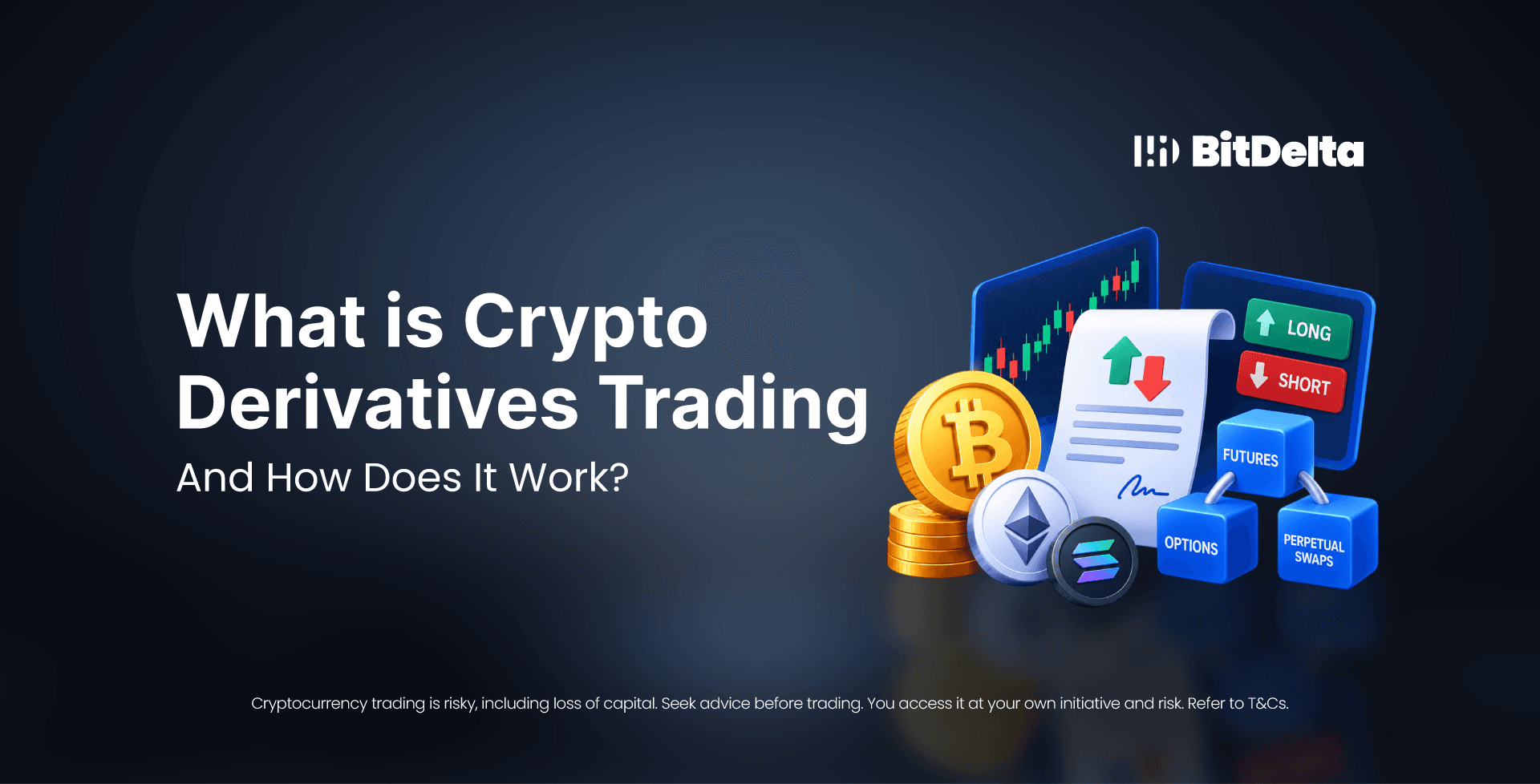
- The main types of crypto derivatives include futures, perpetual futures and options.
- Crypto derivatives offer greater flexibility than spot trading, but that flexibility comes with additional risks.
You do not always need to own Bitcoin to trade Bitcoin.
That is one of the first things to understand about crypto derivatives trading.
Instead of buying and holding a cryptocurrency directly, traders can use financial contracts whose value is linked to the price of an underlying asset such as Bitcoin or Ethereum. That changes the way traders can approach the market, allowing them to speculate on price movements, take long or short positions and, in some cases, use leverage to gain larger exposure with less capital.
It is a different way of participating in the market.
And it comes with different risks.
Crypto derivatives trading has become an important part of digital asset markets because it gives traders more flexibility in how they approach price movements. At the same time, leverage, volatility and liquidation can make these products considerably more complex than simply buying and holding cryptocurrency.
So before getting into strategies, start with the basics: what exactly is a crypto derivative, how does it work and why would a trader use one?
What Is Crypto Derivatives Trading?
Before going further, it helps to understand the word derivative.
A derivative is a financial contract whose value comes from an underlying asset. In crypto markets, that underlying asset can be a cryptocurrency such as Bitcoin or Ethereum.
Crypto derivatives trading, therefore, means trading contracts that track cryptocurrency prices rather than directly owning the underlying coins.
Suppose Bitcoin is trading at $60,000. Instead of purchasing one Bitcoin, a trader could open a derivatives position linked to Bitcoin's price and take a view on where that price might move next.
If the position is structured to benefit from a rise and Bitcoin moves higher, the position may gain value. If Bitcoin falls, the position can lose value.
The cryptocurrency itself does not have to change hands.
That is the key difference.
How Crypto Derivatives Trading Works
Crypto derivatives trading works through contracts offered on trading platforms. The trader selects a contract linked to a particular cryptocurrency and then decides whether they expect its price to rise or fall.
Expect prices to rise?
That is a long position.
Expect prices to fall?
That is a short position.
This ability to trade in both directions is one of the defining features of crypto derivatives trading. In a rising market, traders can seek exposure to potential upside, while short positions provide a way to participate when prices move lower.
Then there is leverage.
Leverage in crypto trading allows traders to control a larger position using a smaller amount of capital. For example, a trader with $1,000 could potentially control a position worth more than $1,000 when leverage is applied, depending on the platform and leverage level available.
Sounds attractive.
But there is a catch.
The same leverage that increases exposure to potential gains also increases exposure to potential losses. A relatively small move in the underlying asset can therefore have a much larger effect on the trader's margin.
That is why risk management is not an optional extra in crypto derivatives trading.
Types Of Crypto Derivatives
Not all derivatives work in the same way. The contract structure matters because it determines how the position behaves, when it settles and what mechanisms apply while it is open.
The main types include futures, perpetual futures and options.
Crypto Futures Trading
Crypto futures trading involves contracts based on an agreed future price for an underlying asset.
Unlike perpetual contracts, traditional futures have an expiry date. At that point, the contract is settled according to its terms.
For example, a trader could enter a Bitcoin futures contract based on where they expect Bitcoin's price to be at a specified future date. If their market view is correct, the position may generate a profit; if the market moves against them, it can generate a loss.
Expiry is the important part.
The contract has a defined end point.
Perpetual Futures Crypto
Perpetual futures are similar to traditional futures, but there is one major difference: they do not have an expiry date.
A trader can generally keep a perpetual position open as long as the relevant margin requirements are met.
But there needs to be a mechanism that helps keep the perpetual contract's price aligned with the underlying spot market. That is where the funding mechanism comes in.
Depending on the relationship between the perpetual price and spot price, funding payments can move between long and short traders.
This structure has made perpetual contracts a widely used instrument in crypto derivatives markets.
Crypto Options Trading
Crypto options work differently again.
An option gives the holder the right, but not the obligation, to buy or sell an underlying asset at a specified price, depending on the type of option and its terms.
A call option generally benefits from an increase in the underlying asset's price, while a put option generally benefits from a decrease.
Options can be used for speculation, but they can also be used as hedging tools.
For example, a trader holding an underlying crypto asset could use an options position as part of a strategy designed to manage potential downside risk.
Different structures, different use cases.
That is what makes the crypto derivatives market so broad.
Crypto Derivatives Vs Spot Trading
The difference between crypto derivatives and spot trading comes down to what you are actually trading.
With spot trading, you buy or sell the underlying cryptocurrency itself.
With derivatives trading, you trade a contract linked to the price of that cryptocurrency.
Consider Bitcoin again.
Buy Bitcoin in the spot market and you own the asset. Open a Bitcoin perpetual position and you have exposure to Bitcoin's price through a derivative contract instead.
The differences do not stop there.
Crypto derivatives can offer leverage and the ability to take short positions, depending on the product and platform. Spot trading, by contrast, generally involves purchasing the underlying asset with available capital rather than controlling a larger position through leverage.
Derivatives can therefore provide greater capital efficiency and flexibility, but they also introduce risks such as liquidation and leveraged losses.
More flexibility.
More responsibility.
Margin Vs Derivatives Trading
These two concepts are often confused because both can involve leverage.
Margin trading generally involves borrowing funds or assets to increase the size of a trade. The trader uses available collateral to support a larger position.
Crypto derivatives trading, on the other hand, involves contracts whose value is linked to an underlying asset. Leverage can be built into the structure of these contracts without the trader directly borrowing the underlying cryptocurrency itself.
The distinction is important because the mechanics, settlement process and risks can differ between the two.
Both can increase potential gains and losses.
Neither should be approached simply because a larger position looks more attractive.
Why Do Traders Use Crypto Derivatives?
The crypto derivatives market exists because traders want more ways to express their market views.
For some, it is about speculation. A trader expecting Bitcoin to rise can take a long position, while someone expecting a decline can take a short position.
For others, derivatives are about hedging. A hedge is a position designed to help manage the potential impact of an adverse price movement elsewhere in a portfolio.
Then there is capital efficiency.
A derivatives position can provide exposure to a larger notional value without requiring the trader to put up the full value of the underlying asset. That can make derivatives useful for active traders who understand how leverage and margin work.
But capital efficiency cuts both ways.
A smaller amount of capital controlling a larger position means that losses can also accumulate more quickly.
Risks Of Crypto Derivatives Trading
This is where the conversation needs to become more serious.
Crypto derivatives can create opportunities, but they can also magnify risk.
Leverage Risk
Leverage increases exposure.
If the underlying cryptocurrency moves in your favour, the return on the capital committed to the position can be amplified. If it moves against you, losses can increase just as quickly.
A small market move can become a large account-level event when leverage is high.
Volatility Risk
Crypto markets can move rapidly.
A position that looks manageable when opened can change significantly during a sharp market move, particularly when leverage is involved.
There is no guarantee that a market will give you time to react.
Liquidation Risk
Liquidation occurs when a trader's available margin is no longer sufficient to support an open leveraged position under the platform's rules.
At that point, the position may be closed automatically.
This is one of the biggest differences between simply holding an asset and trading a leveraged derivative. With a spot position, the asset can generally continue to be held through price declines, while a leveraged derivatives position can be liquidated if margin requirements are breached.
Emotional Decision-Making
Then there is the human side.
Markets move quickly. Traders see a sudden rally and increase leverage. A sharp decline follows, and they react emotionally, perhaps adding to a losing position or changing their strategy without a clear plan.
That can compound losses.
In crypto derivatives trading, discipline matters because leverage leaves less room for mistakes.
How To Trade Crypto Derivatives
Learning how to trade crypto derivatives starts with understanding the contract itself.
Before opening a position, a trader should know what asset the contract tracks, whether it has an expiry date, how leverage works, what the margin requirements are and what happens if the market moves against the position.
From there, the basic process involves choosing a platform, selecting the appropriate contract, deciding whether to go long or short, choosing a suitable leverage level and placing the trade.
Risk controls matter just as much.
Stop-loss orders can be used to manage downside risk, while position sizing helps prevent one trade from exposing too much of the overall trading capital. Positions also need to be monitored because market conditions can change quickly.
The objective is not to predict every move.
It is to have a plan before the move happens.
What Should Beginners Understand First?
If you are completely new to crypto derivatives trading, do not start with leverage.
Start with the contract.
Understand what you are actually trading. Learn the difference between futures and perpetuals. Understand how funding works for perpetual contracts. Learn what margin means and when liquidation can occur.
Then look at leverage.
Not the other way around.
A trader who understands the mechanics can make more informed decisions about risk. Someone who starts with leverage without understanding liquidation can discover the mechanics the expensive way.
You'd better be sure you understand the product before increasing your exposure.
The Bigger Picture
Crypto derivatives trading has changed the way traders participate in digital asset markets. Instead of simply buying and holding cryptocurrencies, traders can use futures, perpetual contracts and options to express views on price movements, hedge positions and manage exposure in different ways.
That flexibility is the appeal.
But flexibility does not mean simplicity.
Futures have expiry dates. Perpetuals use funding mechanisms. Options have their own structures and pricing considerations. Leverage can increase exposure, while margin requirements determine how much room a position has to withstand adverse price movements.
Understanding those differences is the starting point.
From there, risk management becomes central. Position sizing, sensible leverage, stop-loss strategies and continuous monitoring can all play a role in managing the risks associated with derivatives trading.
Crypto derivatives are powerful tools.
Used without understanding, they can become expensive very quickly.
BitDelta.com provides access to crypto derivatives markets alongside trading tools and educational resources designed to help traders understand these products and approach derivatives trading with greater clarity and control.