Trading in Virtual Assets involves significant risk, including the potential loss of your entire capital. None of our communications are intended to provide investment, legal, or financial advice, nor to induce you to trade in such instruments. You should assess your risk tolerance and seek independent expert financial advice before trading. You must ensure that your use of BitDelta’s services complies with all applicable laws and regulations, as further detailed in our Terms and Conditions. Please carefully review our Terms and Conditions, Risk Disclosure Statements, and Security and Privacy Policies to understand the risks involved and the limitations on our liability before using our services. These services are not directed at, and are not available to, residents or citizens of the United Arab Emirates.
Version 8.3.13
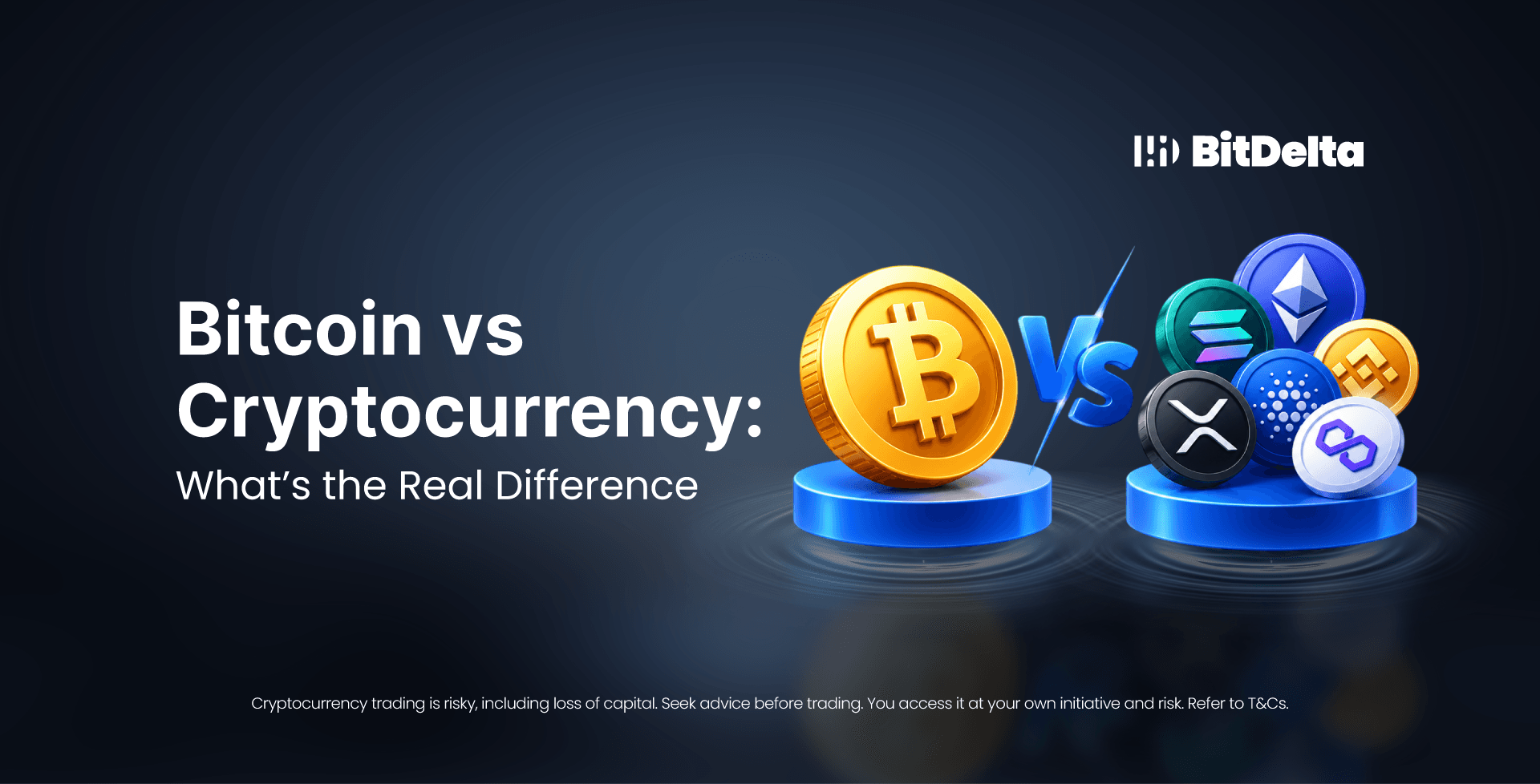
Bitcoin vs Cryptocurrency: What’s the Real Difference and Why Bitcoin Still Leads
Share Article
Key Highlights
Bitcoin is one cryptocurrency, not the entire market
Cryptocurrency includes a wide range of digital assets with different purposes
Bitcoin is mostly seen as a store of value
Many other cryptocurrencies are built for specific use cases
Bitcoin still holds a large share of the overall market
If you ask ten people about crypto, chances are most of them will talk about Bitcoin. For a lot of newcomers, Bitcoin is crypto. It’s the name they hear first, the price they check, the chart they follow. But once you spend a little time in this space, you realise that Bitcoin is just one part of a much bigger picture.
The word cryptocurrency covers everything in this space. Bitcoin sits at the centre of it, but around it there are thousands of other assets, each trying to do something slightly different. Some aim to improve speed, some focus on building applications, and some exist purely because people believe in them. That mix is what makes the market interesting, but also confusing.
So, the real question is not just how Bitcoin is different, but why it still holds such a strong position even after all these years.
When Bitcoin launched, there was no competition. It wasn’t trying to fit into an existing system. It was creating one from scratch. The idea was simple but powerful. Allow people to send value without relying on banks or intermediaries.
For a while, that idea stood alone. Then slowly, other projects started to appear. Some tried to improve what Bitcoin could not do. Others moved in completely different directions. That is how the crypto market expanded into what it is today.
Even with all that growth, Bitcoin never really stepped aside. If anything, it became the anchor of the entire market. You can still see this in its market share. According to CoinMarketCap, Bitcoin continues to take up a significant portion of the total crypto market value.
That kind of staying power is not accidental.
What Is Bitcoin
Bitcoin is a digital currency that runs on a decentralised network. There is no central authority controlling it. Transactions are verified by participants in the network and recorded on a blockchain.
That part is usually easy to understand. What takes a bit longer to sink in is why people value it the way they do.
Bitcoin has a fixed supply. There will only ever be 21 million coins. That limit is built into the system. Because of this, people often compare it to gold. Not because it looks similar, but because it shares the idea of scarcity. Over time, this changed how people used Bitcoin. Instead of spending it like everyday money, many started holding it as an asset.
Think of it less as something you use daily and more as something you keep.
What Is Cryptocurrency
Cryptocurrency is the broader category that includes Bitcoin and everything that came after it.
This is where things start to branch out. Not every cryptocurrency is trying to be money. Some are designed to run networks. Others support applications. Some are built for specific industries like gaming or finance.
That is why the term can feel vague. It covers too much.
Popular Cryptocurrencies Beyond Bitcoin
Bitcoin may be the largest cryptocurrency by market capitalisation, but it is far from the only major digital asset. Several other cryptocurrencies have built strong ecosystems by focusing on different use cases.
Ethereum (ETH) is the second-largest cryptocurrency by market capitalisation. While Bitcoin is primarily viewed as a store of value, Ethereum powers smart contracts and decentralised applications (dApps). It has become the foundation for many decentralised finance (DeFi) platforms and NFT projects.
Solana (SOL) is designed for high-speed, low-cost transactions. Its network processes transactions much faster than many traditional blockchains, making it popular for decentralised applications, gaming projects, and digital collectibles.
XRP focuses on cross-border payments. It aims to help financial institutions move money internationally with greater speed and efficiency, making it one of the most recognised cryptocurrencies in the payments sector.
BNB is the native cryptocurrency of the BNB Chain ecosystem. It is commonly used to pay transaction fees, participate in decentralised applications, and access services across the broader blockchain ecosystem.
These cryptocurrencies have different purposes, communities, and adoption levels. While they remain smaller than Bitcoin in terms of market capitalisation, each plays an important role in expanding the cryptocurrency ecosystem beyond digital value storage.
Key Differences Between Bitcoin and Cryptocurrency
Once you look at them side by side, the difference becomes clearer.
Bitcoin is focused. It has a clear role and has stayed close to that role over time. It is about storing and transferring value in a decentralised way.
Other cryptocurrencies are more varied. They experiment with different ideas. Some succeed, some do not, but they all contribute to the evolution of the space.
This difference also shows up in how they behave in the market. Bitcoin tends to move in broader trends. Other assets can be more reactive and sometimes more volatile.
Bitcoin vs Other Popular Cryptocurrencies
Feature
Bitcoin (BTC)
Ethereum (ETH)
Solana (SOL)
XRP
Primary Purpose
Store of value and payments
Smart contracts and dApps
High-speed blockchain applications
Cross-border payments
Market Position
Largest cryptocurrency by market capitalisation
Second largest cryptocurrency
Leading smart contract platform
Major payment-focused cryptocurrency
Supply
Fixed at 21 million coins
No fixed maximum supply
Inflationary supply model
Maximum supply of 100 billion XRP
Common Use Cases
Investment, value storage, peer-to-peer transfers
DeFi, NFTs, blockchain applications
Gaming, DeFi, NFTs
International money transfers
This comparison highlights that Bitcoin occupies a unique position in the market. While many cryptocurrencies compete by offering new technologies or specialised use cases, Bitcoin continues to lead because of its established reputation, fixed supply, strong liquidity, and widespread recognition among both retail and institutional investors.
Why Bitcoin Still Dominates
You might expect that with so many alternatives, Bitcoin would slowly lose its position. That has not really happened.
Part of the reason is trust. Bitcoin has been around longer than anything else in the space. It has gone through multiple market cycles and has managed to hold its ground each time.
There is also the question of liquidity. Bitcoin is easier to trade in large amounts without causing major price swings. This matters for bigger investors.
When institutions enter the crypto market, they usually start with Bitcoin. It is the most familiar and the most established. That alone keeps a steady flow of capital moving into it.
Bitcoin Dominance Explained
Bitcoin dominance is a simple way to measure how much of the market belongs to Bitcoin.
If the total crypto market is worth two trillion dollars and Bitcoin accounts for one trillion of that, its dominance is fifty percent.
When this number goes up, it usually means more money is staying in Bitcoin. When it goes down, it suggests that money is moving into other cryptocurrencies.
Traders keep an eye on this because it gives a sense of where attention is shifting.
What This Means for Traders
Even if you are not trading Bitcoin directly, it still affects what you do.
Bitcoin often sets the direction for the market. When it moves strongly, other assets tend to follow. When it slows down, traders start looking elsewhere for opportunities.
You will see this pattern repeat over time. It is one of the reasons why understanding Bitcoin’s role matters, even if your focus is on other assets.
Understanding Where Bitcoin Fits
Bitcoin is not the whole crypto market, but it is still the centre of it.
Cryptocurrency is much broader. It includes projects with different goals, different structures and different levels of adoption. But Bitcoin remains the reference point.
That position comes from a mix of history, trust and how the market has developed around it.
Once you understand that, it becomes easier to make sense of the rest of the space instead of treating everything as the same.
BitDelta gives you access to both Bitcoin and the wider crypto market, making it easier to follow how these movements play out in real time.
Disclaimer
Disclaimer: 2026. All rights reserved. This communication is for informational and educational purposes only and should not be construed as financial, investment, or legal advice. BitDelta does not guarantee the accuracy, completeness, or timeliness of the information provided. Trading in cryptocurrency markets involves substantial risk, including the potential loss of your entire investment. Users are advised to conduct their own research, exercise caution, and seek independent financial advice before making any trading decisions. BitDelta is not liable for any losses or damages arising from actions taken based on this communication.