Key Highlights
- The Fear and Greed Index measure the market sentiment
- When fear dominates, there tends to be a drop in the market and an air of uncertainty
- When greed dominates, there tends to be a rally in the market, and traders feel very positive and confident
- The Fear and Greed Index help traders measure the market psychology
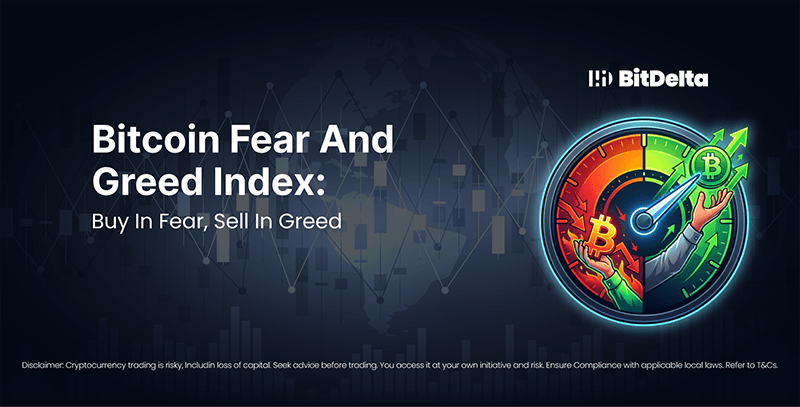
- The basic principle behind the Fear and Greed Index is that if one buys when everyone else is scared, and sells when everyone else is greedy, they do well.
It is common to see sentiments swing rapidly in crypto. On any given day, traders might be very bullish about a coin and invest heavily in it. A few days later, traders could be very bearish about the same coin and avoid it entirely. The prices could change, but the main reason for such fluctuations is usually fear and greed.
That is where the Bitcoin Fear and Greed Index come in. It does not predict the future or help in decision-making. Rather, it tells you the current market sentiment.
In cryptocurrency, this information is particularly useful.
What is the Bitcoin Fear and Greed Index
The BTC Fear and Greed Index allows for tracking sentiment among traders. As opposed to conventional indices that rely mostly on the price factor, this particular one considers behaviour patterns. Multiple indicators have been compiled into one metric, with each one ranging between 0 and 100.
Low values indicate fear, while high values show greed. Values closer to zero signal extreme fear on the market, while values near one hundred signal the opposite, extreme greed.
The idea may seem simple, and that’s what makes the index so efficient.
Why Sentiment Matters in Crypto
Unlike traditional markets which are dominated by institutional trading, the crypto one is still highly retail driven. Hence, reactions can be quite swift and drastic.
In case of a decrease in the price, the fear wave emerges rapidly. Traders feel anxious about their positions and start to sell as soon as they can, without making any additional considerations to avoid possible losses. As a result, prices continue to fall.
On the contrary, when prices grow, investors' confidence starts developing. People buy as much as they can to prevent themselves from losing out.
How The Index Is Calculated
However, the Fear and Greed Index does not consider one particular factor while analyzing the state of the market. On the contrary, its calculations take into account a variety of sources.
These typically include:
- Price volatility
- Volume of trading operations
- Market momentum
- Social media
- Search trends
As it can be seen, each of these factors provides information about the behavior of market participants. Together, they offer an image of current sentiments.
You don't have to analyze each of these factors separately. They all are taken into account during the calculations of one single index.
Buy In Fear Sell In Greed Explained
Though this concept seems simple at first glance, applying it in practice may become difficult.
Buying In Fear
During the times when the market is afraid of something, the price is falling, negative news dominates, and traders' confidence level is quite low. That's why many of them prefer to be inactive at this point.
On the other hand, the state of fear usually means active selling that often leads to overvaluation.
Example
Bitcoin drops sharply from $60,000 to $52,000. The index goes into extreme fear mode. Traders begin to withdraw their investments.
Nevertheless, an experienced trader would treat this situation as a chance rather than a danger.
Selling In Greed
When the market is in greed, prices are rising and sentiment is positive. It feels comfortable to stay in the trade because everything is moving up.
This is also when risk quietly builds.
Example
Bitcoin rallies from $60,000 to $70,000. The index moves into extreme greed. Traders become confident that the rally will continue.
At this stage, some traders start taking profits instead of entering new positions.
How Traders Actually Use It
On its own, the index is rarely used. In most cases, traders use the index in a contextual manner. The primary aim is determining whether the market has an emotional sentiment at present.
If it is so, it means it's easier to step out of the current market. Some traders make use of the index together with price levels and setups. Others use it to confirm whether a particular price action is overbought or oversold.
Common Mistakes
One common mistake among traders is using the index as a timing tool. Even when traders note that the market is in fear, it may take some time before the prices change direction. The same applies to greed.
Another common mistake is ignoring the overall trend in the markets. This can be seen where a strong uptrend takes more time to move into greed. Likewise, a downtrend tends to take more time before moving into fear.
What This Means for Traders
While sentiment analysis provides traders with a competitive advantage, the correct usage of such knowledge is essential for success.
The objective is not to challenge the market trends every day. Instead, it is vital to identify the moments when emotions override rational decision-making.
In situations where fear is prevalent, it can serve as a warning signal that the trader should proceed with caution. If greed dominates the market, then the trader needs to be careful with their investment.
With time, these factors will enable investors to develop a more balanced approach to their investments.
Reading The Market Beyond Price
The Bitcoin Fear and Greed Index is a simple idea, but it reflects something deeper. Markets are not just numbers and charts. They are driven by people, and people react emotionally.
By paying attention to sentiment, traders get a better sense of what is happening beneath the surface.
The phrase buy in fear and sell in greed is not about predicting the market. It is about understanding behaviour.
BitDelta gives traders access to real-time market data and tools that help track both price and sentiment, making it easier to stay informed and make more structured trading decisions.