Key highlights
- Blockchain technology is able to protect data from manipulations
- Artificial intelligence utilizes data for various purposes
- In combination, they produce smart systems that are also reliable
- The application of such a combination spans across many spheres including financial, medical and logistics ones
- Blockchain enhances the trustworthiness of AI
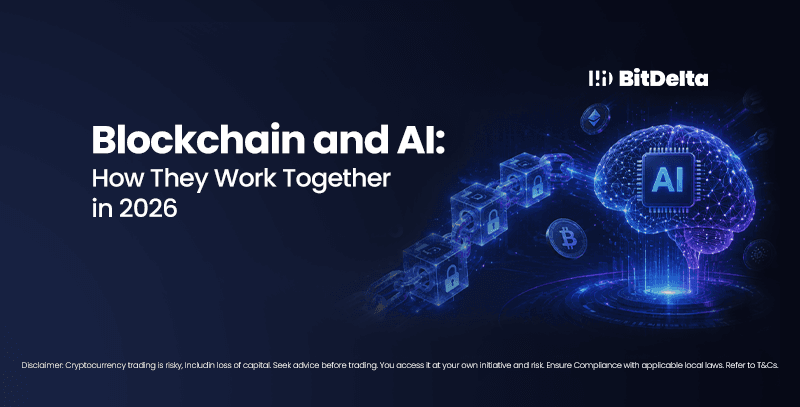
Until recently, discussions regarding blockchain technology have been quite independent from AI. While the former technology was considered the backbone of crypto and decentralized solutions, the latter shaped automation and data analysis processes. At present, more and more projects start joining these two technologies into unified systems, and it becomes obvious why the integration is so inevitable.
The point is, blockchain is all about trust and data security, while artificial intelligence deals with making decisions and predictions based on collected data. As such, the combination creates a powerful synergy between the transparency of the processes and their reliability and efficiency.
And here come some real-life applications of the technologies discussed, which become quite apparent nowadays. The only dependency artificial intelligence has is data. The better data, the better results obtained. Yet data comes with a whole bunch of issues associated with the protection and storage processes.
Here enters blockchain technology.
Blockchain enables storing and monitoring data in a transparent and hardly modifiable manner. The data collected by AI solutions is trustworthy when taken from a reputable source.
In 2026, the relationship between AI and blockchain will become more useful and obvious. In addition to considering both trends independently, developers start thinking about synergies between them.
What Blockchain Brings To AI
Blockchain cannot be used to analyse data. Nevertheless, it can be applied to monitor the data.
As a solution might be considered rather complex, the use of a blockchain ensures its integrity and reliability. Indeed, when a database could potentially be modified, an algorithm built on its basis loses its integrity and reliability.
Blockchain makes it possible to collect all the updates in a transparent and hardly modifiable manner.
Example
Let's consider an AI system for forecasting ship delays. The system analyzes data about shipments and uses them to estimate future shipment delays. As the data is monitored via a blockchain network, there is no possibility of using incorrect data or altering the existing one.
What AI Brings to Blockchain
By itself, blockchain technology is relatively inflexible for analysing big data and making decisions. And here comes AI.
With artificial intelligence, you get the ability to work with a lot of data, identify patterns, and predict events. Integrating AI into blockchain systems may increase their efficiency and automate various processes.
Example
For example, in blockchain-based financial systems, AI can be used to analyse transaction patterns and automatically identify potentially suspicious cases without manual checks.
Where They Work Together
However, the true potential emerges when both blockchain and AI are implemented in one and the same project.
Data Integrity And Decision Making
Firstly, the blockchain guarantees the integrity of data which serves as an input for decision-making done by AI algorithms.
It limits the degree of error between input data and output decisions. The integrity of input data increases confidence in results.
Automation With Transparency
Secondly, AI can execute automated actions. However, these actions can hardly be verified since they are automatically performed without any trace. Blockchain allows creating a record of each and every action, thus facilitating auditing processes.
Decentralised AI Systems
Another issue about AI is centralisation. There are just a few companies that store all the data and train models.
Blockchain offers a way to distribute data and access. This can support more open AI systems where control is not concentrated in one place.
Real-World Use Cases
By 2026, researchers have found ways of applying blockchain along with artificial intelligence in various industries.
For example, in the finance sector, the AI system will analyse the available information, while the blockchain will record transactions. In the sphere of healthcare, blockchain will be able to protect patients' personal data, while AI will help with diagnosing and analysing.
In logistics, blockchain will keep track of the movement of goods while AI will calculate the optimal route. It may seem early yet, but there are already such applications of these innovative technologies.
Challenges To Consider
Despite numerous benefits, there are practical difficulties that should be taken into account.
First, blockchain is much slower than the conventional system. At the same time, AI systems require rapid data processing and massive databases.
What This Means Going Forward
One more issue worth mentioning is the challenge related to scalability. Both systems are expected to grow, but it might be difficult to integrate them efficiently. These problems exist, but there are some solutions being created.
Apart from purely technical problems, one more important aspect worth discussing is how trustworthy the blockchain combined with AI is. While AI systems tend to function like black boxes, blockchain guarantees transparency.
Why Blockchain and AI Work Well Together
Though blockchain and AI address different issues, they complement each other well when working together.
Whereas the former lends formality and trust to the information, the latter enables one to analyse and use the data effectively. The integration of blockchain and AI would likely be more prominent in the future as these technologies progress.
BitDelta sits at the intersection of this evolving landscape, giving users access to advanced trading environments, real-time market data and tools designed for a more data-driven approach. As markets become more influenced by technology, having the right platform to interpret and act on information becomes just as important as the information itself.