Key Highlights
- Bitcoin is a cryptocurrency which serves as an asset
- Blockchain is the technology used to record transactions
- Bitcoin is one of blockchain applications but there are many others
- Blockchain is already applied in various fields by 2026
- Bitcoin is still the most famous and popular crypto asset
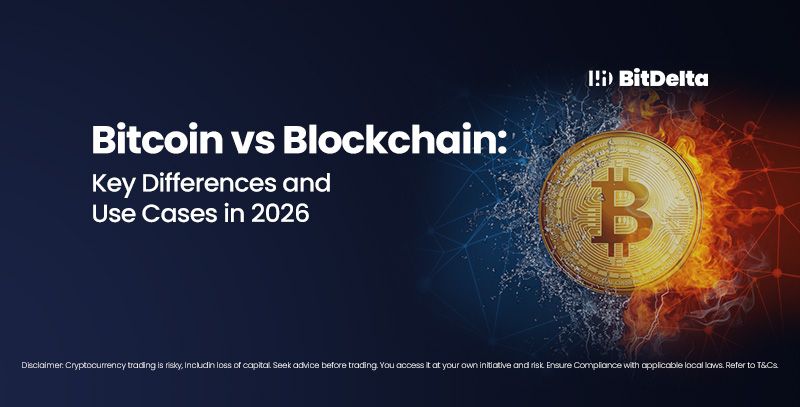
Confusing Bitcoin and blockchain happens quite often even in 2026, although they refer to different things. It would be logical to confuse these terms because the terms are related but blockchain and Bitcoin cannot substitute each other. While Bitcoin is the asset people can trade, blockchain is the technology used to record transactions.
The different is important since it helps to understand why Bitcoin can be considered an asset whereas blockchain has potential to become something much more than cryptocurrency.
Back in the days when Bitcoin became well known, only the idea of digital money was popular whereas no one paid any attention to blockchain as such. However, with time, more and more interest has been shown to the technology behind cryptocurrencies.
The development of both technologies by 2026 demonstrates their evolution to different directions. Blockchain finds its usage in such industries as finance, logistics, digital property management. On the other hand, Bitcoin still remains loyal to its purposes; therefore, it is widely used as a currency to store and transfer value.
It is important to analyse the development paths of these two technologies and their applications to understand better the future of the industry.
What Is Bitcoin?
Bitcoin can be described as decentralized digital money. The main characteristic of this asset is that users can directly transfer values between each other without the interference of any third parties.
All transactions are processed through the blockchain technology and recorded in the blockchain permanently.
It is essential to note one more significant advantage of Bitcoin, limited supply. The maximum number of Bitcoins that may appear is 21 million; thus, many individuals prefer to treat them as some form of investment rather than an everyday payment.
Example
For instance, if a user transfers Bitcoins to another user, it is verified through the blockchain and registered permanently. No banking institution or any other centralised system verifies transactions made in this way.
What Is Blockchain?
Blockchain refers to a technology used by the cryptocurrency Bitcoin; however, blockchain is independent from Bitcoin.
It acts as a decentralized ledger in which information is stored within a network. The information is divided into sets known as blocks, and the blocks are arranged in order. Due to its design, it becomes difficult to edit any data once stored, which helps maintain transparency.
Example
A logistics firm can implement the use of blockchain technology to follow the journey of their goods. All stages of transportation are recorded and cannot be easily edited.
Key Differences Between Bitcoin and Blockchain
The most straightforward way to view their relationship would be to consider them separate layers.
Bitcoin refers to the application that is run by a blockchain.
Bitcoin can transfer value, whereas blockchain can store and manage information.
Bitcoin serves a specific purpose. Blockchain is versatile and has been adapted according to need.
That is why Bitcoin is always analyzed in terms of price, while blockchain is analyzed regarding development.
Use Cases of Bitcoin in 2026
However, the usage of Bitcoin in payments became less popular with time, and the application of this cryptocurrency took its definite place. The majority of Bitcoin's uses include keeping the currency as a form of investment. This currency becomes a part of an investor's assets.
Moreover, it becomes helpful when transferring money between countries and institutions in cases when conventional banking services do not work well. Interest of institutional players to Bitcoins increased because investment vehicles based on Bitcoin became available for them.
Use Cases of Blockchain in 2026
There is a number of spheres in which blockchain is currently used. Moreover, it appears that the technology can be applied not only in the area of cryptocurrencies. This technology becomes useful in the sphere of finance. Thus, there emerge lending platforms for borrowing and trading money without intermediaries.
In the area of logistics, the use of the blockchain system assists in tracing products as well as their origins. As for entertainment, it helps in creating games that involve players' rights for digital property outside the gaming platform.
ID systems can use the blockchain technology to keep personal data securely and independently from any central database.
Why the Distinction Matters?
When considering Bitcoin and blockchain as one phenomenon, it may become more difficult to determine what is going on.
Bitcoin adjusts its behavior to the market trends and investor expectations. The development of blockchain continues to evolve in the process of innovation and implementation. These phenomena interact, yet the process does not proceed identically.
Acknowledging the differences between them will prove beneficial in assessing the market, analyzing projects, and defining priorities.
What This Means for Users and Traders?
For the traders, Bitcoin usually serves as an indicator of trends. Price changes in this cryptocurrency affect the other coins.
For the developers and end-users, blockchain represents an opportunity to go beyond the trading aspect. This technology enables the creation of new applications independent from conventional infrastructure.
They are both relevant and equally important, yet play different roles.
Understanding Bitcoin and Blockchain in 2026
Bitcoin and blockchain emerged simultaneously yet followed distinct paths.
The former became a widespread instrument of value transfer within the decentralized network. In turn, blockchain expanded into multiple spheres of activity. The distinction will make it easier to operate in this environment without becoming confused.
The platform BitDelta provides access to crypto markets and the means to study Bitcoin and blockchain separately.